
Okehampton Community Garden Produce Days
As part of the Together for Tomorrow’s spotlight on income diversification for community groups to help launch Proper Job’s new how-to guide, we spoke to Okehampton Community Garden about how they developed their Produce Days.
About our Community Garden
Okehampton Community Garden is a community-led growing project that brings people together to grow fruit, vegetables and flowers, learn new skills, spend time outdoors and connect with others. We aim to create an inclusive and welcoming space where people can get involved regardless of their previous gardening experience. Alongside the growing itself, the garden has become a place for community connection, volunteering and sharing. We grow a range of seasonal produce, with volunteers taking a share of what is grown and surplus produce being made available to the wider community.
How the idea started
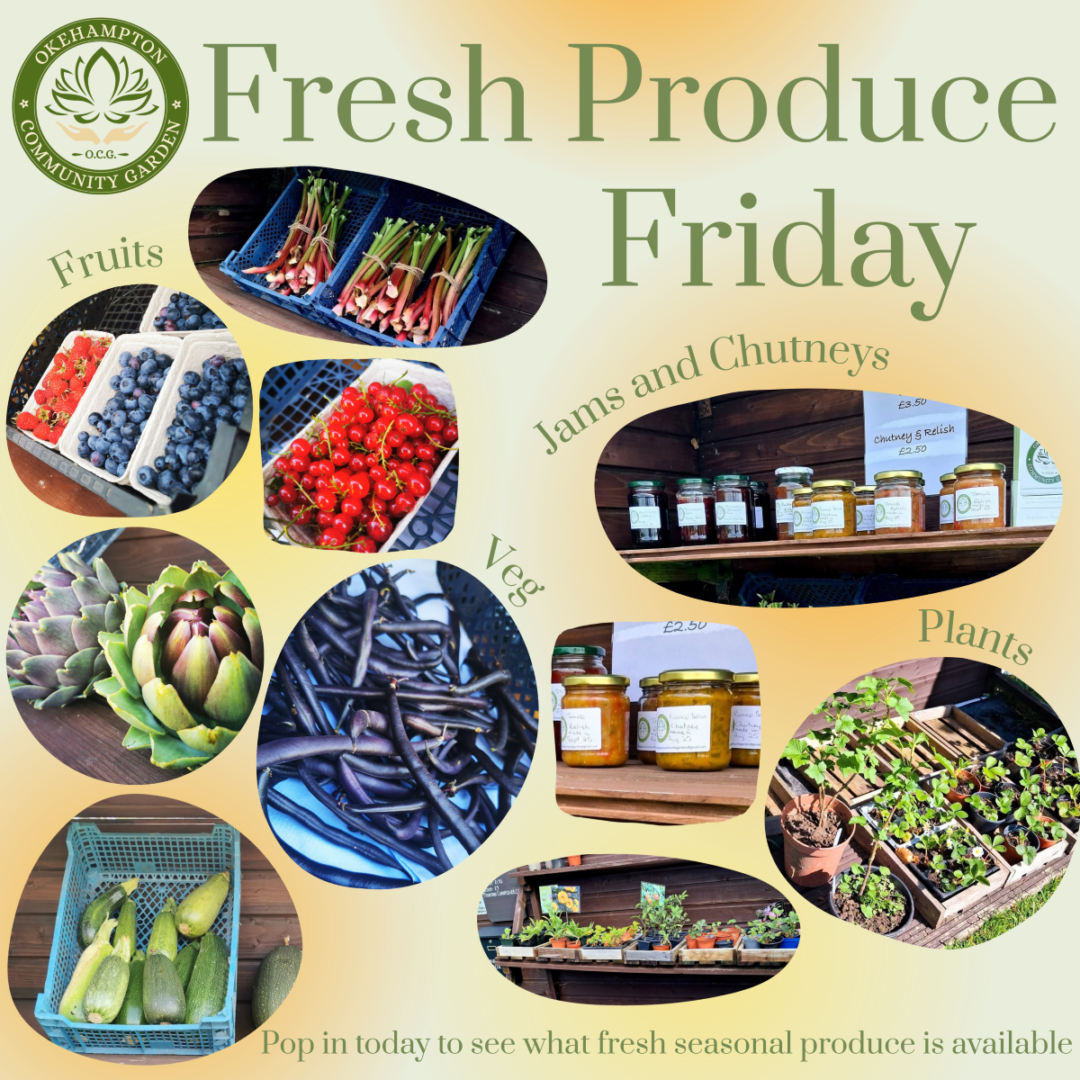
The idea for our Produce Days came about quite organically rather than as the result of a formal income generation plan. At the beginning of the 2025 growing season, we had a particularly bumper crop of rhubarb. Once our volunteers had taken what they wanted, we had a significant amount of good quality produce left over. We didn’t want it to go to waste, so we decided to make the surplus available to the local community. We initially offered the rhubarb for free or in return for donations, this ensured that anyone who couldn’t afford to donate could still take some home. The response was really positive, and it made us realise that there was potential to do something similar with the seasonal surplus throughout the growing season.
What began with rhubarb therefore developed into regular Produce Days, offering a changing selection of fruits and vegetables as they became available.
Running with the idea
One of the strengths of the idea was that it didn’t require us to create an entirely new activity. We already had the produce, the volunteers and the community space. The Produce Days simply allowed us to make better use of something we were already producing. The idea was discussed amongst the volunteers and developed through experience. Rather than committing significant money or resources to a new venture, we were able to try something relatively low-risk and see how the community responded.
There were several important considerations. Firstly, we wanted the Produce Days to remain consistent with the values of the Community Garden. We didn’t want income generation to mean that access to our produce became restricted to people who could afford it. Secondly, we wanted to avoid waste. If we had more produce than the volunteers could use, making it available locally seemed like a much better option than allowing it to go unused.
Finally, we wanted the activity to have a benefit beyond simply raising money. We were particularly pleased to discover that the Produce Days also gave people who had never visited the Community Garden a reason to come along and find out what happens here.
How the Produce Days work
The Produce Days are based around surplus seasonal produce from the garden. Our volunteers have the opportunity to take their share of the harvest first. Any remaining good-quality produce is then made available to members of the local community. We ask for donations, but there is no fixed price and nobody is excluded because they cannot afford to contribute. People can take what they need and give a donation if they are able to.
This approach felt particularly appropriate for a community garden. It means that our produce remains accessible to everyone, while those who are able to contribute help support the ongoing running of the garden. It also means that the offering changes throughout the year. Rather than selling a fixed product, we respond to what the garden is producing at any particular time.
How did it go?
The first full year of Produce Days in 2025 was very encouraging. We ran them almost every Friday throughout the main growing season, from April to October. Across the season, we estimate that around 150 visits were made to the garden specifically for Produce Day.
The Produce Days generated approximately £900 in donations, providing a valuable additional income stream for the Community Garden. However, the financial return was only part of the success. The regular Friday Produce Days also created a new point of contact between the garden and the wider community. For many visitors, this was their first opportunity to discover that the Community Garden existed. Some people came specifically for the produce, while others became interested in what else was happening at the garden.
The Produce Days therefore helped us to generate both income and engagement.
What have we gained from it?
The Produce Days have provided us with a valuable additional income stream, but the benefits have gone well beyond the money raised.They have helped us to:
- make better use of surplus produce and reduce waste;
- provide good-quality, pesticide-free fruit and vegetables to the local community;
- keep produce accessible regardless of people’s income;
- generate approximately £900 of additional income in 2025;
- bring around 150 visits to the garden over the growing season;
- introduce many local people to the Community Garden for the first time;
- raise awareness of what we do and the opportunities available at the garden;
- create another opportunity for conversations and connections within the community; and
- demonstrate that a community project can generate some of its own income from the resources it already has.
In many ways, the increased visibility has been just as valuable as the income. People who initially came to collect some vegetables have discovered the garden, found out about our activities and met the volunteers.
Developing the idea in 2026
Following the success of the Produce Days in 2025, we had hoped to develop the idea further in 2026. Our plan was to make the weekly Produce Day more of a social event, with the possibility of offering tea, coffee and cake alongside the seasonal produce. We felt this could provide another modest income stream while creating an opportunity for people to stay, chat and spend time together rather than simply collecting their vegetables and leaving.
Unfortunately, the weather conditions in 2026 have made this a little difficult. The adverse weather has affected the growing season and reduced the quantity and variety of some of our fruit and vegetables. As a result, we haven’t had the same level of surplus available, and expanding the Produce Days into a larger weekly social event has not been viable this year.
Nevertheless, we have continued to offer what we can. Even with the reduced harvest, the Produce Days remain a worthwhile offering to the people of Okehampton and continue to provide an opportunity for people to access fresh, locally grown produce.
The experience has also reinforced an important lesson for us: income from a community growing project needs to be flexible enough to respond to the growing conditions.
What have we learned?
Perhaps the biggest lesson for us has been that income diversification doesn’t necessarily mean that it needs to be complicated or to take major financial risks. Sometimes it is about looking at what you already have and asking whether there is a different way of sharing or using it.
Our Produce Days grew from a simple problem – having more rhubarb than we could use – into an income generating activity that also supported our wider community objectives.
We’ve also learned the importance of flexibility. Growing is inherently unpredictable, and 2026 has demonstrated how much the weather can affect both the quantity and timing of what we can offer. Having an income idea that can adapt to what the garden produces has therefore been important.
The opportunity to have a cup of tea, eat some cake and chat with other people could make the Produce Days an even stronger way of bringing people into the garden and encouraging them to become involved.
Looking ahead
We would like to continue developing the Produce Days when growing conditions allow, and revisit the idea of adding refreshments and making them a more regular social occasion.
We are also interested in exploring other ways of generating income that build on the things we already do well, such as, growing, sharing skills, bringing people together and making use of our community space.
Potential future ideas could include workshops, seasonal events, expanding on plant sales or other activities linked to the garden and the growing year.
For us, the key will be finding opportunities that generate income without losing sight of why the Community Garden exists in the first place.
Support from organisations such as CAG Devon, provides opportunities to share ideas with other community projects, and gain access to advice that would help us to explore future possibilities with greater confidence.
The bigger picture
The Produce Days have shown us that income generation and community benefit don’t have to be separate things.
What started as a surplus crop of rhubarb has become a small but valuable income stream, a way of reducing food waste, a means of making fresh produce available to local people, and an opportunity to introduce people to the Community Garden.
In 2025 alone, weekly Produce Days generated approximately £900 while bringing around 150 people into the garden.
For us, that is what makes the idea particularly successful: We are not simply generating income from the garden. We are generating income in a way that strengthens what the garden is here to do.
Curious about how to make more money for your community group?
Check out Proper Job’s Income Diversification Toolkit here.

